Blog/ Revenue cycle

How to fill in the reduction or surcharge factor
Learn how to correctly fill in the TISS fields that apply rates to the value of procedures. This article explains how to use decimals and avoid common errors that lead to denials in settlements with health plans

- By
- Rivio, Editorial team
- Published
- Reading time
- 2 minutes


The Reduction or Surcharge Factor (Fator de Redução ou Acréscimo) is a TISS field used on hospitalization, physician fee, SP/SADT and other expenses forms. Its purpose is to apply a percentage surcharge or reduction to the value of the item billed, without having to change the procedure’s original unit value.
What the TISS standard says
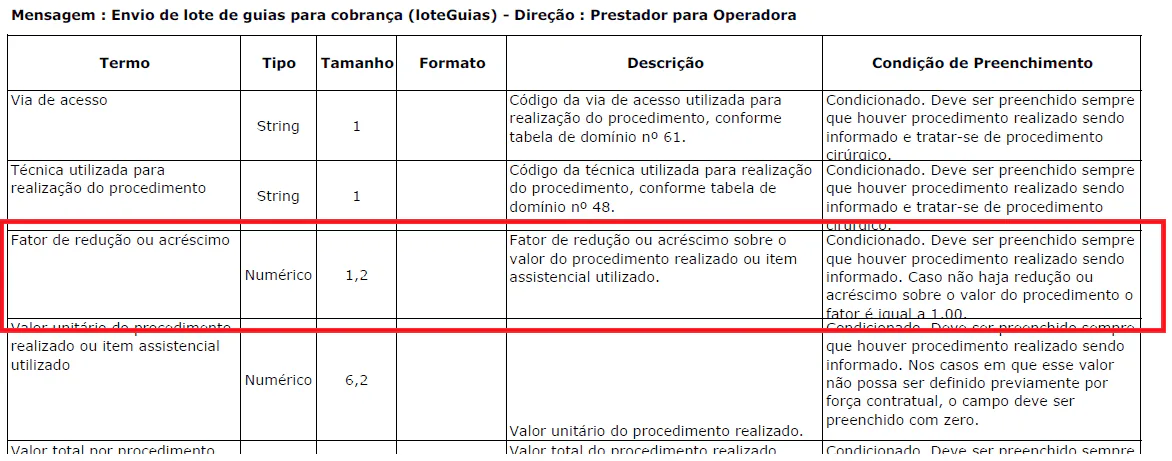
Using the field is simple, but it requires attention to a few criteria to avoid inconsistencies in billing.
1. When the provider has already recalculated the value
If the final value of the procedure has already been calculated and entered directly in the Procedure unit value field, the Reduction or surcharge factor field must contain the value 1.00.
In this scenario, there is no surcharge or reduction, because the adjustment has already been made by the provider’s billing department.
2. When the percentage adjustment will be applied by the health plan
If the provider wants to increase or decrease the procedure’s value by a percentage, the Procedure unit valuefield must remain unchanged, and the desired percentage must be entered only in the Reduction or surcharge factor field.
Practical examples
-
20% surcharge
Original unit value kept and factor entered as 1.20.
The health plan will automatically interpret that the value should be increased by 20%. -
10% reduction
Original unit value kept and factor entered as 0.90.
The health plan will apply the 10% reduction to the value of the procedure.
Watch out for errors that lead to denials
-
Never enter the percentage in the Reduction or surcharge factor while also entering an already adjusted value in the Procedure unit value field.
This duplication is not allowed by the TISS standard and may result in the invoice being denied. -
Always use a period (.) as the decimal separator in the Reduction or surcharge factor field.
Using a comma can cause the health plan’s system to misinterpret the value.