Blog/ Hospital auditing

What are paper and electronic audit cover sheets?
Understand what paper and electronic audit cover sheets are and how each one is used in hospital claims auditing.

- By
- Rivio, Editorial team
- Published
- Reading time
- 3 minutes


The audit cover sheet (capeante) is a document widely used in hospital claims auditing whose purpose is to record and consolidate all the findings made during the audit process. It contains the observations made by the health plan’s physician and nurse auditors, validated jointly with the auditors of the audited provider.
In practical terms, the cover sheet brings together the main audit information, such as data on the hospital claim, the provider, the payer and the patient and, above all, the denied items, that is, those that will not be paid after the technical review.
Is there a standard audit cover sheet?
There is no single cover sheet model adopted by the market. However, the itemized entries usually mirror the structure of the hospital claim itself, covering categories such as daily rates, fees, materials, drugs, OPME (implants and special materials), tests and physician fees.
This similarity makes it easier to check, negotiate and track denials throughout the audit process.
Paper cover sheets: the limitations of the traditional model
The paper cover sheet, still used in some institutions, has significant limitations. Manual recording increases the risk of inconsistencies, makes information harder to trace, compromises data quality and slows the process down, in addition to exposing sensitive patient information to security risks.
Reliance on handwritten notes, parallel spreadsheets and “claim mirrors” makes it difficult to consolidate the negotiations carried out during the external audit.
Electronic cover sheets: more security, traceability and intelligence
As audit processes evolved, many payers and providers began adopting the electronic audit cover sheet, integrated into audit systems. This model improves information security, raises data quality and reduces operational errors.
Beyond these advantages, the electronic cover sheet allows a level of detail that managers rarely explore. It is possible to identify which items were denied, in which cost center and in which care unit, such as the operating room or the ICU, and to break down each component of the denial, for example specific materials or individual supplies.
This degree of traceability expands analytical capacity, enables more precise indicators, supports integration with Business Intelligence (BI) tools and creates a structured foundation for artificial intelligence applications.
Electronic consensus and the end of paper
With specialized solutions such as Rivio, payer and provider auditors stop using paper and manual spreadsheets and start recording their findings directly in the Electronic Consensus module. This allows the negotiation of the hospital claim to take place in a transparent, structured and fully digital way.
At the end of the process, the system automatically generates the cover sheet and the control spreadsheets that audit teams traditionally produced by hand.
All findings remain available for electronic consultation, making it possible to cross-check the deliveries of the audited claims and ensuring full traceability of the work carried out in the external audit, without having to search for scattered records or physical documents.
Gains for auditors and managers
With the electronic cover sheet, both audit teams gain speed, standardization and analytical insight. Structured access to information makes it possible to quickly identify the most denied items, the most negotiated points and the main causes of disagreement, making the process more efficient and accurate.
Rivio offers two cover sheet models: one organized by the item groups of theTISS standard (Procedures, Materials, Drugs, Daily rates, Fees, Packages and Own codes) and another based on custom groupings defined by the healthcare institution itself.
More than an operational record, the cover sheet becomes a strategic source of information. The way auditors and managers use this data defines the maturity level of the audit and its real impact on the institution’s financial and care performance.
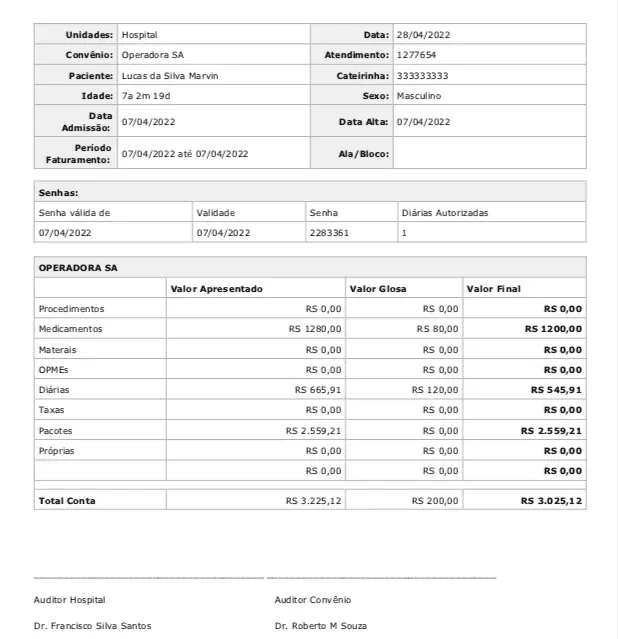
Audit cover sheet template generated by Rivio