Blog/ Healthcare technology

Digital health: the current Brazilian landscape
Understand the concept of digital health in Brazil, its main challenges and the data from the SDB Indicators Dashboard on telehealth between 2020 and 2025.

- By
- Rivio, Editorial team
- Published
- Reading time
- 5 minutes


Digital health is a concept tied to the use of information and communication technologies to support, optimize or deliver health services. It encompasses practices such as telehealth (including teleconsultations and telemonitoring), electronic records, mobile health applications (mHealth), data analytics and artificial intelligence solutions applied to care and clinical management.
In Brazil, digital technology is increasingly used to broaden access, improve the efficiency of health services and generate data that support clinical and administrative decisions. This article shows the current state of digital health in the country and the challenges for the coming years.
An overview of digital health in Brazil
In Brazil, digital health gained prominence from 2020 onward, with the adaptations made necessary by the covid-19 pandemic. Its consolidation, however, has gone far beyond an emergency response. Digital technology has the potential to reduce regional inequalities, increase operational efficiency and improve the care provided to patients, in both the public and private systems.
The evolution of digital health in the country can be observed through the Saúde Digital Brasil (SDB) Indicators Dashboard, published in 2025. This initiative provides an objective view of the behavior, access and outcomes of digital care in Brazil between 2020 and 2025.
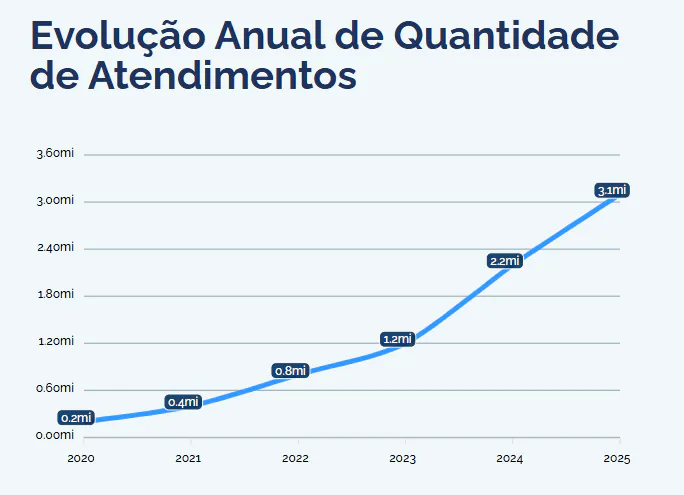
According to the dashboard, nearly 8 million digital consultations were carried out in the period analyzed. In 2020, the annual volume was in the hundreds of thousands of consultations; in 2025, it exceeded 3 million consultations.Exponential, sustained growth of telemedicine in the country.
Source: https://saudedigitalbrasil.com.br/painel-de-indicadores/
States with the most consultations
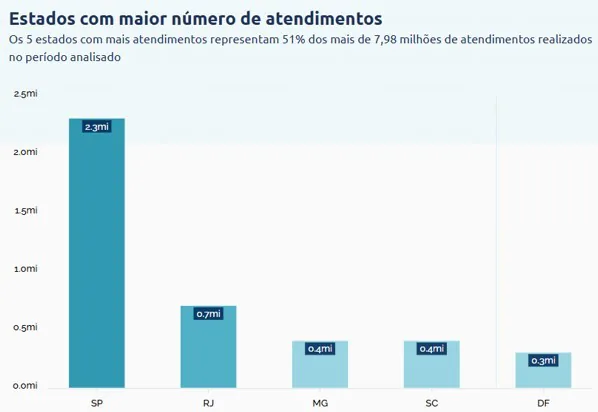
Of the top five states by number of consultations, three are in the Southeast, one is in the South, and the fifth is the Federal District. These five states account for 51% of the more than 7.98 million consultations carried out in the period analyzed.
Source: https://saudedigitalbrasil.com.br/painel-de-indicadores/
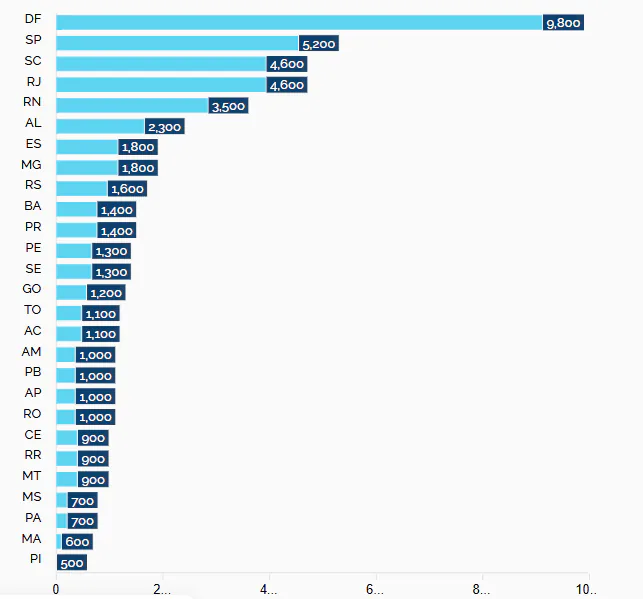
To get a more precise picture of regional inequality, the study also looked at the number of consultations per 100,000 inhabitants. This makes it possible to assess the numbers in proportion to the population. On this measure, the Federal District ranks first, with 9,800 consultations, and Piauí is the state with the lowest proportional number, 500 consultations.
Source: https://saudedigitalbrasil.com.br/painel-de-indicadores/
As for how the consultations are paid for, about 42% are funded by health plans regulated by ANS (Brazil’s National Supplementary Health Agency), 31% by companies covering their employees and 8% by SUS (Brazil’s public health system). The remaining 19% come from other sources or were not reported to the study.
Does telemedicine resolve cases in clinical practice?
The SDB indicators show that telemedicine in Brazil has a high degree of clinical resolution. Approximately 73% of digital consultations are concluded in the remote setting itself, with no need for referral to an in-person visit. This figure shows that telemedicine does not act merely as triage, but as a care model capable of resolving real clinical needs.
The vast majority of consultations take place by videoconference, which ensures higher quality in the clinical assessment. In addition, digital consultations lead to important clinical follow-ups: a significant share result in test orders, medical certificates and prescriptions, including for controlled drugs, in compliance with current regulations.
The percentage of in-person referrals is relatively low, so the proper use of digital health helps relieve pressure on physical services, optimize schedules and direct in-person care only to cases that truly require on‑site assessment.
What are the main challenges of digital health in Brazil?
Despite significant progress, the consolidation of digital health in Brazil still faces structural challenges.
One of the main ones is interoperability between systems. The fragmentation of platforms, medical records and databases hinders continuity of care and limits the strategic use of clinical information throughout the patient journey.
Another critical point is unequal access to digital infrastructure. Regions with poor connectivity or populations with lower digital literacy face additional barriers to fully benefiting from telehealth services, which calls for specific public policies and solutions adapted to local realities.
The integration of digital health into SUS also requires attention. Although there are successful initiatives, national scale requires standardized workflows, continuous investment in technology and professional training.
Finally, data protection and information security are central concerns. The processing of sensitive health data must strictly comply with Brazil’s General Personal Data Protection Law, with governance, traceability and robust controls across the entire care chain.
Trends for the future of digital health in the country
Data from the SDB Dashboard indicate that digital health in Brazil is likely to evolve toward more integrated and continuous models of care. Teleconsultation is expected to become an increasingly routine part of Brazilians’ lives, along with follow-up strategies such as telemonitoring of chronic patients.
Another trend is the growing use of digital clinical data as a strategic asset, supporting care planning, risk management, auditing, billing and evidence-based public policymaking.
In this context, technologies such as artificial intelligence, process automation and predictive analytics are gaining ground, not to replace professionals, but to expand analytical capacity, reduce waste and increase the efficiency of the health system.
The Rivio view
The consolidation of digital health in Brazil shows that the value lies not only in remote care but in the ability to turn clinical data into operational and financial intelligence. As the volume of digital consultations grows, so does the complexity of managing information, auditing and the hospital revenue cycle.
Rivio was founded to transform hospital management through artificial intelligence. In a landscape under growing pressure from costs, regulatory complexity and operational inefficiencies, we believe technology is the way to bring financial predictability, scale and intelligence back to healthcare’s administrative processes.
Our vision is clear: to build the best operating system for healthcare in Latin America, starting with the hospital revenue cycle. By automating analysis, reducing rework and supporting decisions with reliable data, we help hospitals operate more efficiently, free up their teams’ time and create the conditions to focus on what really matters: quality of care and the patient experience.