Blog/ Hospital auditing

Why concurrent audit matters for hospitals
Understand how continuous review during the hospital stay optimizes the revenue cycle and identifies care failures and billing inconsistencies in real time to reduce denials and raise the quality of patient care

- By
- Rivio, Editorial team
- Published
- Reading time
- 2 minutes


In a hospital, concurrent audit is a continuous review that takes place at the same time as care. It starts the moment the patient is admitted and continues day after day, checking that records, prescriptions and charge entries are correct and aligned with institutional protocols and standards. The goal is to ensure the quality, compliance and completeness of the claim before discharge.
Goals of concurrent audit
The central goal is to identify, while care is still under way, potential problems that could compromise quality or billing, such as:
-
care errors;
-
deviations from clinical protocols;
-
regulatory inconsistencies;
-
items not entered;
-
opportunities for correction and improvement before discharge.
By acting at the moment care takes place, concurrent audit keeps failures from moving further along the revenue cycle and reduces administrative rework.
Who performs concurrent audit
The work is carried out by specialized professionals, such as nurse auditors, physician auditors or multidisciplinary quality review teams.
These professionals evaluate care records and data in real time, checking that care follows good clinical practices, institutional standards and applicable regulations.
Main benefits of concurrent audit
The main benefits of concurrent audit in healthcare include:
-
better quality of patient care;
-
a shorter time to submit the claim to the health plan;
-
fewer denials from health plans;
-
fewer items left unbilled on the medical claim;
-
prevention of medical errors;
-
lower costs related to rework or inappropriate treatment;
-
greater regulatory compliance;
-
more efficient healthcare operations.
How to implement concurrent audit
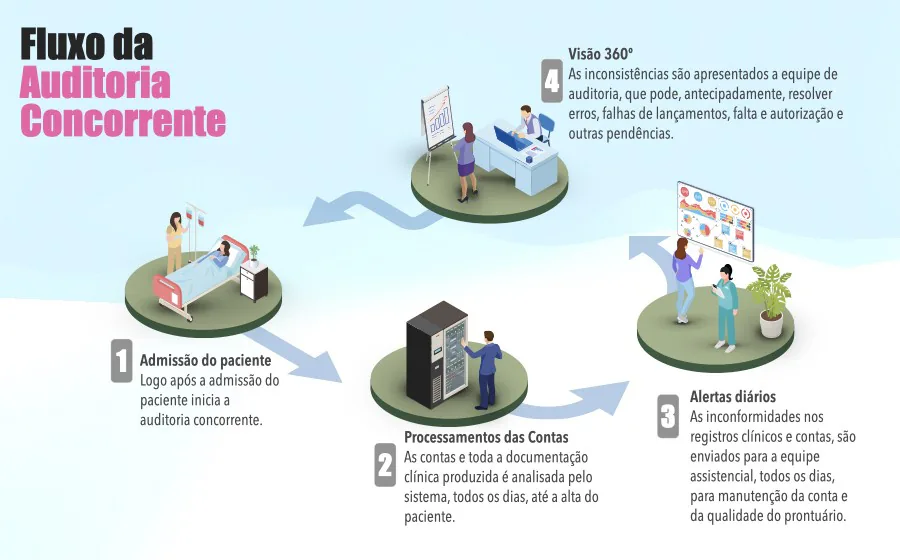
Implementation requires a cultural shift and adjustments to care and administrative workflows. Managers and teams need to align processes to allow continuous review of the claim. A typical workflow includes:
-
Patient admission: opening the claim and checking documentation.
-
Daily review of records: checking prescriptions, progress notes, materials, drugs and procedures.
-
Immediate correction of inconsistencies: adjustments made by the responsible department before care moves forward.
-
Recording interventions: documenting the audit’s actions.
-
Final review before discharge: confirming that the claim is complete, correct and authorized.
This model prevents a backlog of pending issues and reduces the time it takes to close claims.
See an example of a concurrent audit workflow below:
How can technology help?
Technology expands the capacity of concurrent audit by allowing every claim to be evaluated daily by computerized systems. Specialized platforms automate recurring tasks, fix inconsistencies and alert the responsible departments immediately.
A practical example: when the system identifies a missing authorization, it automatically alerts the authorizations department to obtain the document and avoid billing delays at discharge. The same applies to prescription discrepancies, items incompatible with the diagnosis, materials not entered and health‑plan‑specific rules.
By incorporating automation, analytics and integration between departments, concurrent audit becomes faster, broader and more accurate. This practice reduces risks, speeds up payments and strengthens the revenue cycle.